Real Estate Market Intelligence Engine
Where bank stress and county exposure predict forced inventory before it lists. The Market Intelligence Engine is the pre-supply read across 33,458 ZIP codes, 3,235 counties and 4,228 FDIC banks - built to show which markets are turning first, not which ones already turned.
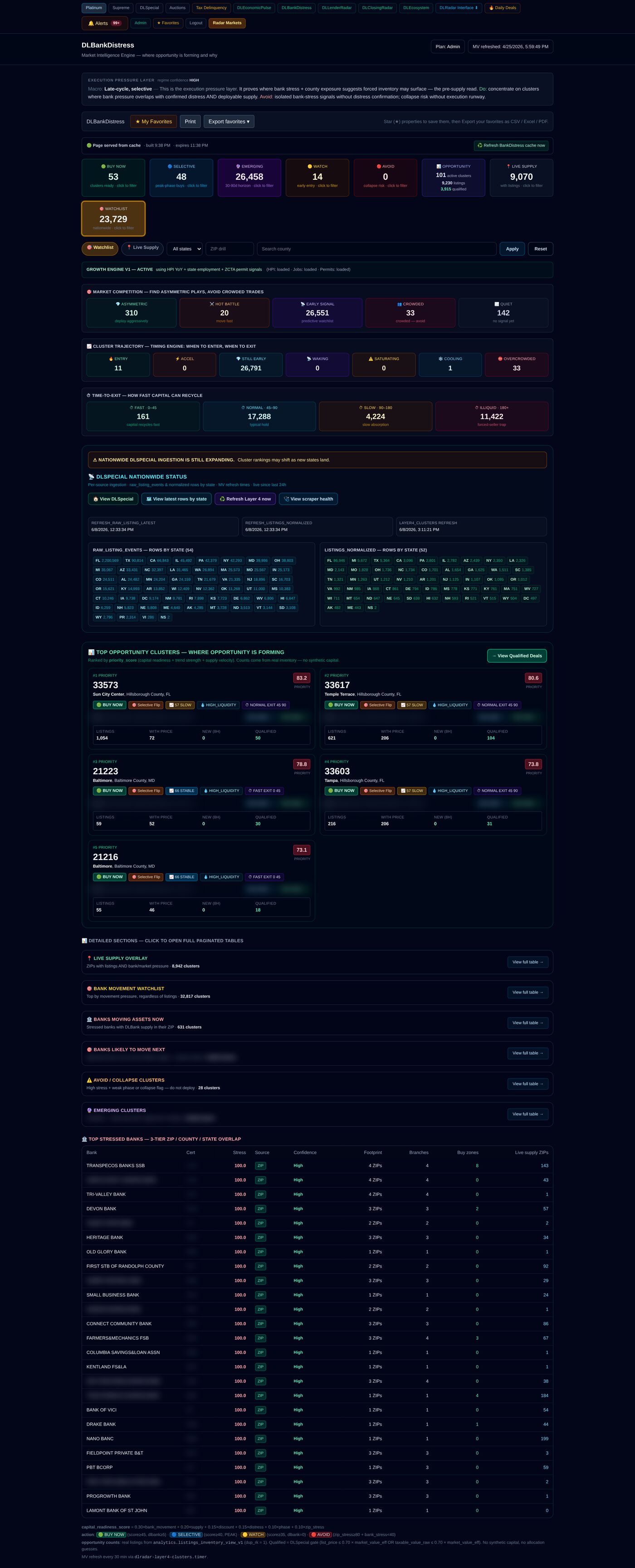
Actual DLRadar results · record-level detail unlocks with a plan
National coverage and stress at a glance
Live aggregates from DLRadar's institutional bank-stress and county-exposure views.
From bank balance sheets to forced inventory
Distressed supply does not appear at random. It starts on a lender's balance sheet. When an FDIC bank accumulates stressed real estate loans, it eventually tightens new credit, works out troubled notes, and moves distressed collateral to market. The Market Intelligence Engine scores that pressure for every bank and maps it onto the ZIP codes and counties each bank actually lends into - turning a balance-sheet problem into a geographic forecast of where forced inventory is most likely to build.
Bank stress alone is a signal, not a certainty. That is why the engine runs a distress-confirmation gate: a market only lights up when independent, public-record distress signals confirm what the bank-stress read implies. DLRadar tracks 27 distinct distress categories - from pre-foreclosure and tax delinquency to lien and lending-footprint stress - and requires confirmation before a ZIP or county is promoted into a live distressed-property cluster. Clusters are then tiered STRONG BUYERS MARKET, BUYERS MARKET, EMERGING, and WATCH so an investor can separate concentrated buyers-market conditions from markets that are still forming.
The result is a forward-looking, national map of pressure. Of the 4,228 FDIC banks tracked, 4,184 carry a measurable stress score, and 3,124 of the 3,235 counties in coverage contain at least one stressed lender. That is the pre-supply read: the markets where the next wave of distressed inventory is being manufactured right now.
Banks at the top of the stress scale
FDIC institutions at the top of the 0-100 bank-stress scale, ranked by ZIP footprint. Public FDIC identities; aggregate footprint only.
| Bank (FDIC) | Stress | ZIP footprint |
|---|---|---|
| Devon Bank | 100 | 178 |
| Adirondack Bank | 100 | 154 |
| Nano Banc | 100 | 92 |
| Transpecos Banks Ssb | 100 | 88 |
| Fieldpoint Private B&T | 100 | 70 |
| Tioga-Franklin Savings Bank | 100 | 49 |
| Bank Of Glen Burnie | 100 | 42 |
| Progrowth Bank | 100 | 39 |
| Columbia Savings&Loan Assn | 100 | 37 |
| First State Bank Of Red Wing | 100 | 36 |
Methodology
Every score is deterministic. The same inputs always produce the same output - there is no black-box model guessing at prices. Bank stress is derived from public FDIC data; county exposure is built from each lender's branch and lending footprint; and distress confirmation comes from public records. Scores are normalized to a 0-100 scale, refreshed on a schedule, and rolled up from ZIP to county to national so the read is consistent at every zoom level. DLRadar publishes only aggregates on this page - counts, scores, and public FDIC bank identities - never owner, parcel, or account-level personal data.
Explore the engine
Each layer of the Market Intelligence Engine has its own public view.
Get ahead of the next distressed-inventory wave
The public engine shows where pressure is building. A DLRadar plan unlocks the distressed-property inventory inside each cluster - with scores, signals, and acquisition tools.
Frequently asked questions
What is a real estate market intelligence engine?
It is a deterministic system that scores where distressed housing supply is likely to build next. Instead of waiting for foreclosures to hit the MLS, the Market Intelligence Engine reads bank stress, county lending exposure, and local distress signals to flag the markets turning first - the pre-supply read across the entire U.S.
How does bank distress predict real estate supply?
Banks that carry stressed commercial and residential real estate loan books eventually tighten credit, call loans, and push distressed collateral to market. By mapping each FDIC bank's stress score onto the ZIP codes and counties it lends into, DLRadar turns balance-sheet pressure into a forward read on forced inventory before that inventory is listed.
What are distressed property clusters?
A cluster is a group of adjacent ZIP codes where bank stress, county exposure, and confirmed distress signals line up at the same time. Clusters are tiered so investors can separate BUY_NOW concentrations from SELECTIVE, EMERGING, and WATCH markets that are still developing.
Where does the data come from?
Coverage is built from public FDIC bank data, county lending footprints, and public-record distress signals - refreshed on a schedule and scored deterministically. No proprietary, private, or owner-level personal data is used to produce the public market intelligence view.