National Real-Estate Operator Network
The people and companies who actually move U.S. real estate — agents, brokers, investors, cash buyers, wholesalers and operators — assembled into one verified, provenance-tagged network. The value is not a list you buy once; it is a living directory where every operator is tied to a public source of record and refreshed from that source over time.
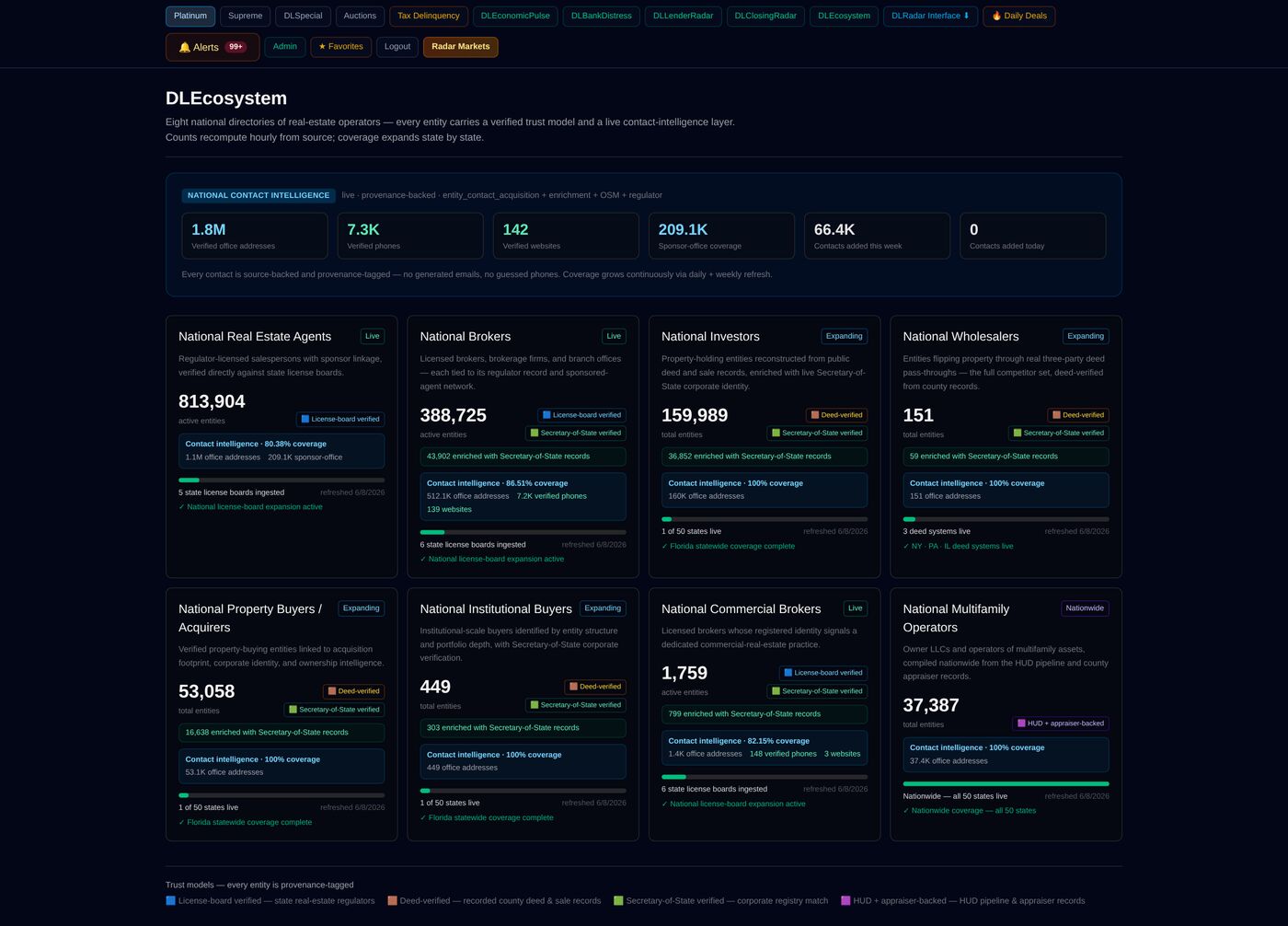
Actual DLRadar results · record-level detail unlocks with a plan
The eight directories
Live operator counts per directory. Counts recompute from source on a schedule; coverage expands state by state.
Beneath the directories runs a contact-intelligence layer: 1,894,959 verified office addresses, alongside 10,965 verified phones and 165 verified websites — every one sourced from a regulator file, a public deed, or a Secretary-of-State registration rather than a purchased list.
What each operator type is
Licensed agents
Individual real-estate salespeople published by state license boards. Each record is tied to a live, unexpired license and, where available, cascaded to the sponsoring brokerage's verified office address — never a guessed personal number.
Brokers
Principal and managing brokers whose license authorizes them to run a brokerage. Brokers anchor an office address that is regulator-published, which is why the network can verify where an agent actually practices.
Investors
Buyers identified from repeat-transaction and deed activity — the operators who acquire, hold, and reposition property rather than occupy it. Provenance is the public deed record, not a self-reported list.
Cash buyers / acquirers
Entities with a demonstrated pattern of non-financed or rapid acquisitions. This is the audience wholesalers and disposition desks look for: buyers who close without a lender in the loop.
Wholesalers
Operators who contract distressed property and assign it on. Wholesaler records carry a real contact address plus the county/state flip footprint where they are actually active.
Multifamily operators
Owners and operators of apartment portfolios, aggregated by property name and state from appraiser rolls and the HUD pipeline. Each is sized by property and unit count so you see institutional versus small operators at a glance.
Commercial brokers
Brokers whose practice is commercial rather than residential, carried as a distinct directory so commercial-deal outreach is not diluted by the residential majority.
Institutional buyers
Funds, REITs and large corporate acquirers — the smallest directory by count but the highest by capital deployed. Verified against Secretary-of-State registrations.
The trust model
Every operator carries a provenance tag that says why it is trusted. License-board verified records — agents, brokers and commercial brokers — are matched to a live, unexpired state license, and their office is the regulator-published practice address. Deed-verified records — investors, cash buyers and wholesalers — are derived from the public transaction record, so an operator is only classified as a buyer because deeds say so. Secretary-of-State verified records — institutional buyers and corporate entities — are checked against state business registrations. Multifamily operators are aggregated from appraiser rolls and the HUD pipeline and sized by property and unit count. Because provenance is attached to the record, you never have to take the network's word for it.
Methodology
The network is built by ingesting authoritative public sources per state — license-board rosters, county deed and transaction records, appraiser rolls, HUD multifamily data and Secretary-of-State filings — then deduplicating and cross-linking them into operator entities. Contacts are attached only when a real, source-backed field exists: a regulator practice address, a Secretary-of-State mailing address, or an acquired office phone or website. Where an agent has no address of their own, the sponsoring brokerage's verified office is cascaded on and clearly flagged as the brokerage's, never faked as personal. Aggregate counts recompute on a schedule; the record-level detail stays gated behind daily unlock caps so the data remains clean and defensible. No number on this page is an estimate — each is a live count of real, provenance-tagged rows.
Build your operator list
This is the free network overview. A DLRadar plan opens the record-level directory — verified office contacts, acquisition footprints, and one-click list building across all eight directories — so you can go from a market to a targeted operator list in minutes.
The rest of the deal stack
The operator network is one layer of DLRadar's acquisition stack. Pair it with the capital and closing layers, and with the distress intelligence that surfaces the deals in the first place:
Frequently asked questions
How are contacts verified?
Every operator is tied to a public source of record, not a purchased list. Agents and brokers are matched to live state license-board files; investors, cash buyers and wholesalers are derived from the public deed record; institutional and corporate entities are checked against Secretary-of-State registrations. Office addresses come from regulator-published practice addresses and Secretary-of-State mailings — over 1 million of them — so a contact is only shown when a real, source-backed field exists. Nothing is fabricated or inferred as personal.
What makes this a network rather than a list?
A list is a static export that decays the moment it is sold. This is a living directory: counts recompute on a schedule from source, coverage expands state by state, and every operator carries a provenance tag (license-board, deed-verified, or Secretary-of-State) so you always know why a record is trusted. The value is in the verified, cross-linked relationships — an agent to its brokerage, a buyer to its acquisition footprint — not a one-time dump of rows.
Which operator types are covered?
Eight directories: licensed agents, brokers, investors, cash buyers / acquirers, wholesalers, multifamily operators, commercial brokers and institutional buyers — 1.4M++ operators in total, plus a contact-intelligence layer of 1M+ source-backed office addresses spanning them.
Is the data free?
The aggregate network counts and coverage on this page are free. The record-level directory — names, verified office contacts, acquisition footprints and one-click list building — is part of a DLRadar plan, with per-list daily unlock caps so the data stays clean and defensible.